
You clean the bathroom properly, and two days later the white marks are back. On the tiles near the shower, on the taps, around the base of the mixer, on the glass partition.
These are hard water stains, and in many Indian homes they’re a daily fight, especially where the water comes from a borewell.
I’ve been in the tile and bathware business for about 15 years, and this is one of the most common questions customers ask me. The good part is that hard water stains are easy to remove once you use the right thing. The bad part is that many people use the wrong thing, usually strong acid from the market, and end up damaging their grout, taps or marble for good.
This guide covers exactly what to use on each surface, how long to leave it, and what you should never use.
What Hard Water Stains Actually Are
Hard water has a lot of dissolved minerals in it, mainly calcium and magnesium.
When water dries on a tile or tap, the water goes but the minerals stay behind. Every bath adds a thin new layer. After a few weeks, you get white, chalky marks. After a few months, you get a hard, crusty layer, which is called limescale.
That’s why hard water stains show up most in these places:
- Tiles around the shower and bucket area
- The base of taps and mixers
- Shower heads, where the small holes get blocked
- Glass shower partitions
- Around the drain and floor trap
- Inside the WC, as a yellowish or brown ring at the water line
Because these deposits are minerals, mild acids dissolve them. That’s why vinegar and lemon work. It’s also why you need to be careful, because acid can harm some surfaces too.
First, Make Sure It’s a Hard Water Stain
Before you start scrubbing, check what kind of stain it is. Different stains need different treatment.
| What it looks like | What it probably is | What works |
|---|---|---|
| White, chalky, rough when dry | Hard water (limescale) | Mild acid like vinegar or lemon |
| Grey, greasy film that feels slippery | Soap scum | Warm water with dish soap, or vinegar |
| Orange or brown patches | Rust, from iron in the water or old pipes | Rust remover made for tiles |
| Black spots in corners and grout lines | Mould or fungus | Mould cleaner, and better air flow |
| Dull, rough patches on marble that don’t wipe off | Etching (the marble surface is damaged, not stained) | Needs polishing, not cleaning |
In most bathrooms, soap scum and hard water are mixed together. The good news is that vinegar handles both.
What You’ll Need
You don’t need anything expensive. Most of this is already in your kitchen:
- White vinegar (the plain kind used for cooking)
- Lemons or citric acid powder (sold as “nimbu sat” in Indian stores)
- Baking soda
- A spray bottle
- A soft brush and an old toothbrush
- Microfibre cloths or soft cotton cloths
- A rubber squeegee, for glass and tiles
- Rubber gloves
Open the bathroom window or run the exhaust fan while cleaning.
How to Remove Hard Water Stains From Tiles
This method is for ceramic, vitrified and porcelain tiles, which covers most bathroom tiles in Indian homes.
For light stains
- Mix white vinegar and water in equal amounts in a spray bottle.
- Spray it on the stained tiles.
- Leave it for 5–10 minutes. Don’t let it dry out.
- Scrub gently with a soft brush.
- Rinse well with clean water.
- Wipe the tiles dry. This step matters. If you let them air-dry, new water marks form straight away.
For heavy, crusty stains
- Use undiluted white vinegar. Slightly warm vinegar works faster.
- Soak a cloth or paper towel in it and stick it on the stained area. This keeps the vinegar in contact with the stain, especially on walls, where it would otherwise run down.
- Leave it for 15–20 minutes.
- Scrub with a brush, then rinse and dry.
- For stubborn spots, make a thick paste of baking soda and a little water, rub it gently over the area, then rinse.
Use the vinegar and the baking soda one after the other, not mixed together in a bowl. When you mix them, they fizz and cancel each other out. The vinegar does the dissolving, and the baking soda paste is just a gentle scrub.
You may need to repeat this two or three times on very old deposits. That’s normal. It’s much better than using something harsh once.
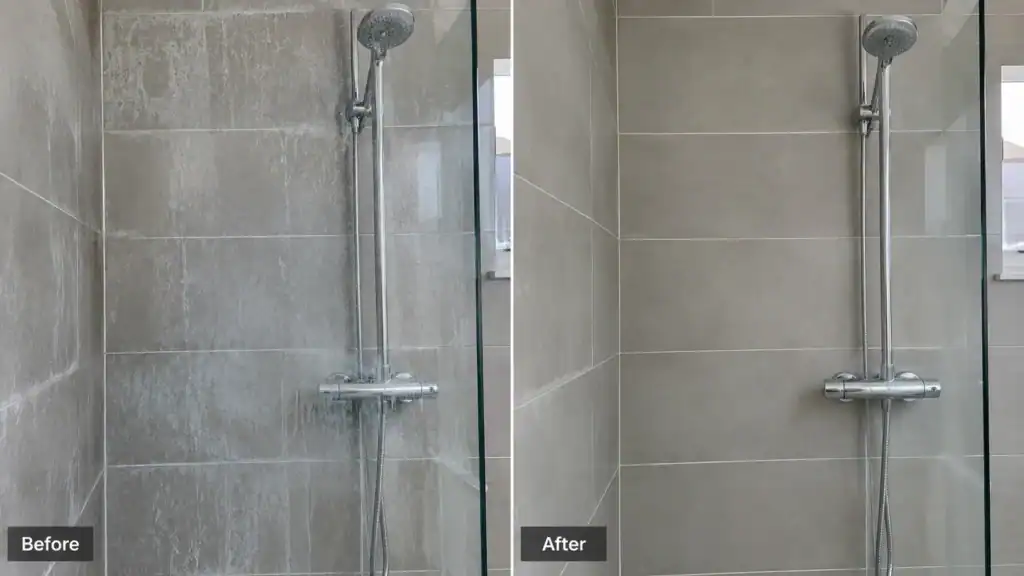
Be careful with the grout
This is the part many people miss.
Normal cement grout is damaged by acid. Vinegar won’t harm it in a short clean, but if you soak grout in vinegar again and again, or use strong acid, the grout slowly gets weak, rough and starts to crumble.
So:
- Don’t leave vinegar on grout for long periods.
- Always rinse the grout lines well with plain water afterwards.
- If you have epoxy grout, you don’t need to worry much, because it handles acid far better.
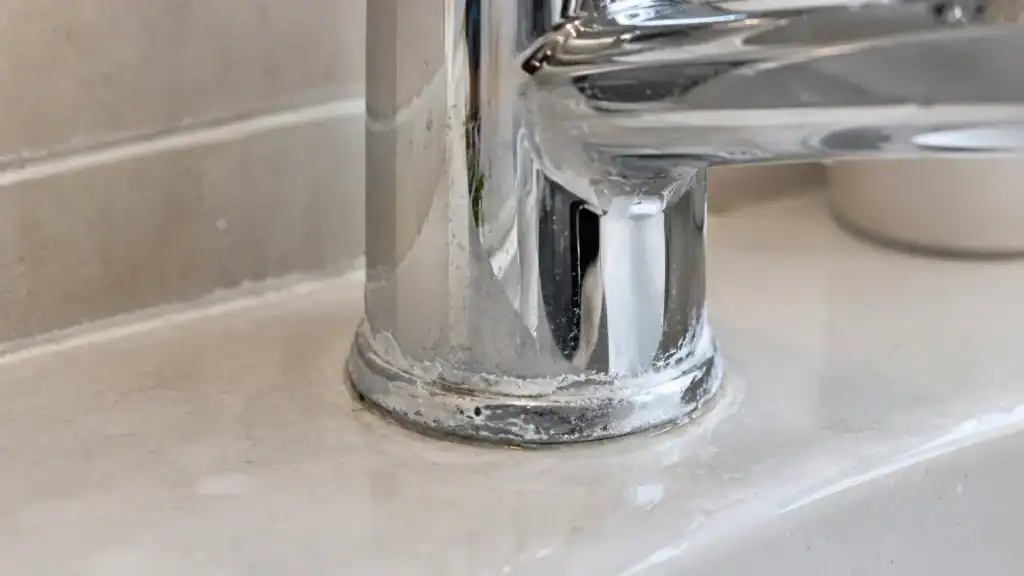
How to Remove Hard Water Stains From Taps and Mixers
Most bathroom taps in India are chrome-plated. Chrome can handle mild vinegar, but it scratches easily, so no steel wool or hard scrubbers.
The cloth-wrap method (works best)
- Soak a cloth or paper towel in white vinegar.
- Wrap it tightly around the tap, especially the base where the white crust builds up.
- Leave it for 30 minutes to 1 hour for heavy deposits, or 10–15 minutes for light marks.
- Remove the cloth and scrub gently with an old toothbrush, especially around the base and the joints.
- Rinse with water and dry with a soft cloth until it shines.
The lemon method (for light stains)
Cut a lemon in half and rub it directly on the tap. Leave it for 5–10 minutes, then rinse and dry. It’s quick, and it smells better than vinegar.
Don’t forget the aerator
The small mesh at the mouth of the tap is called the aerator. It collects a lot of limescale, which is why the water flow becomes weak or uneven.
Unscrew it (most come off by hand or with a gentle twist using a cloth for grip), soak it in vinegar for an hour, brush it with a toothbrush, rinse and screw it back.
A warning about coloured and designer finishes
Matte black, gold, rose gold, brushed nickel and other special finishes are becoming popular. Many of these should not be cleaned with vinegar or any acid, because it can remove or dull the finish.
For these, use only mild soap and water, dry them after every use, and check the manufacturer’s care instructions before trying anything stronger.
How to Clean a Shower Head Blocked by Hard Water
If your shower sprays in random directions, or some holes don’t work at all, limescale is almost always the reason.
If you can remove the shower head:
- Unscrew it.
- Soak it in a bowl of white vinegar for 1–2 hours. For very heavy scale, leave it overnight.
- Scrub the face with a toothbrush.
- Rub the rubber nozzles with your finger to push out any scale left inside them.
- Rinse, fit it back, and run hot water through it for a minute.
If you can’t remove it:
Fill a plastic bag with vinegar, pull it up so the shower head is fully dipped, and tie it tightly around the arm with a rubber band. Leave it for a couple of hours, remove it, then scrub and rinse.
How to Remove Hard Water Stains From Glass Shower Partitions
Glass shows hard water marks more than anything else in the bathroom.
- Spray undiluted white vinegar on the glass.
- Leave it for 10–15 minutes.
- Wipe with a soft cloth or non-scratch sponge.
- For stubborn spots, rub gently with a baking soda paste.
- Rinse and dry with a squeegee, then polish with a dry microfibre cloth.
If the glass stays cloudy even after proper cleaning, the surface may have been etched by years of hard water. That damage is in the glass itself, and cleaning won’t fully remove it.
Citric Acid: A Stronger Home Option
For heavy limescale where vinegar is too slow, citric acid powder (nimbu sat) works well.
Mix roughly one tablespoon in a glass of warm water, and use it like vinegar: spray or wipe it on, leave it for 10–15 minutes, scrub and rinse well.
It’s stronger than vinegar, so the same warnings apply even more: rinse grout properly, keep it off marble and special tap finishes, and don’t leave it on for long.
What Never to Use
I see a lot of damage from the wrong cleaners. Please avoid these.
Strong acid (“tezaab” or muriatic acid)
Many people use this because it removes stains very fast. But it:
- Eats cement grout, leaving the joints rough, weak and open to water
- Damages chrome taps and fittings permanently
- Can dull or mark tile glaze over time
- Destroys marble and other natural stone
- Gives off harmful fumes in a closed bathroom
For a normal home bathroom, it’s simply not worth the damage.
Mixing cleaners
Never mix bleach with vinegar, acid, or acid-based toilet cleaners. The mix releases a harmful gas. If you’ve used one cleaner, rinse the surface well with plain water before using another.
Steel wool and hard scrubbers
They scratch chrome, glass and glossy tiles. Once scratched, surfaces actually pick up stains faster.
If You Have Marble or Natural Stone
This deserves a separate section, because the usual hard water advice will ruin marble.
Marble, Kota stone, limestone and travertine should never be cleaned with vinegar, lemon, citric acid or any acidic cleaner. These stones are made of calcium carbonate, the same material as limescale. So the acid that dissolves the stain also dissolves the stone, leaving dull, rough spots called etch marks.
| Surface | Safe to use vinegar or lemon? |
|---|---|
| Ceramic, vitrified and porcelain tiles | Yes, rinse grout well |
| Chrome taps and shower heads | Yes, briefly, then dry |
| Glass shower partitions | Yes |
| Matte black, gold and other special tap finishes | No, use mild soap only |
| Marble, Kota, limestone, travertine | No, never |
| Granite | Better to avoid; use a stone-safe cleaner |
For hard water marks on marble:
- Use a pH-neutral stone cleaner and a soft cloth.
- For light marks, gently wipe with warm water and dry immediately.
- If the marks have become dull patches, that’s usually etching, and it needs polishing, not cleaning.
I’ve covered the safe methods in detail in how to remove stains from marble. If your marble floor has lost its shine because of years of water marks, see how to make marble and tile floors shine again.
How to Stop Hard Water Stains From Coming Back
Cleaning removes the stains. These habits stop them building up again:
- Wipe the taps and wet tiles dry after bathing. It takes a minute and makes the biggest difference.
- Keep a squeegee in the bathroom and use it on glass and shower-area tiles after each bath.
- Spray diluted vinegar once a week on tiles and glass (not marble). Light, regular cleaning is much easier than scraping thick deposits later.
- Run the exhaust fan or keep a window open so the bathroom dries faster.
- Consider a water softener if your water is very hard. It treats the water before it reaches your taps and reduces deposits on tiles, fittings, geysers and appliances. It’s the only real long-term solution for very hard water.
If you’re choosing new fittings, remember that dark matte finishes and polished chrome both show hard water marks clearly. Lighter, brushed finishes tend to hide them better.
Bottom Line
Hard water stains are mineral deposits left behind when water dries. On ceramic and vitrified tiles, chrome taps, shower heads and glass, white vinegar is the safest and most effective home cleaner. Use it diluted for light stains and full strength for heavy ones, then rinse and dry.
Keep acid away from grout for long periods, and never use vinegar, lemon or strong acid on marble, Kota or other natural stone. Avoid “tezaab” completely.
After that, it’s mostly habit. Wipe things dry after bathing, clean lightly every week, and install a water softener if your water is very hard.
FAQ
What is the best home remedy for hard water stains on bathroom tiles?
White vinegar mixed with equal parts water works for light stains. For heavy stains, use undiluted vinegar on a soaked cloth for 15–20 minutes, then scrub, rinse and dry. This is for ceramic and vitrified tiles, not marble.
How do I remove white marks from bathroom taps?
Wrap a vinegar-soaked cloth around the tap for 30 minutes to an hour, then scrub gently with an old toothbrush, rinse and dry. For light marks, rubbing half a lemon on the tap also works. Don’t use this on matte black or gold finishes.
Can I use vinegar on marble to remove hard water stains?
No. Vinegar and lemon dissolve marble and leave dull etch marks. Use a pH-neutral stone cleaner, and if the marble has dull patches, it needs polishing.
Is it safe to use acid (tezaab) to clean bathroom tiles?
It’s better not to. Strong acid damages cement grout, chrome fittings and natural stone, and gives off harmful fumes. Vinegar or citric acid, used with care, is much safer.
Why do hard water stains keep coming back?
Because every time water dries on a surface, it leaves a fresh layer of minerals. Wiping surfaces dry after bathing, weekly light cleaning and a water softener are the best ways to stop them.
How do I clean a shower head blocked by hard water?
Soak it in white vinegar for one to two hours, or overnight for heavy scale. If you can’t remove it, tie a vinegar-filled plastic bag around it. Then scrub and rub the rubber nozzles to clear them.
Does vinegar damage grout?
A short clean followed by a good rinse is fine. But leaving vinegar on cement grout for long periods, or using it again and again without rinsing, slowly weakens the grout. Epoxy grout handles it much better.
How do I remove hard water stains from glass shower doors?
Spray undiluted white vinegar, leave it for 10–15 minutes, wipe with a soft cloth and use baking soda paste for stubborn spots. Rinse and dry with a squeegee. If cloudiness stays, the glass may be permanently etched.
Before publishing: The experience lines (“I’ve been in the business for about 15 years”, “I see a lot of damage from the wrong cleaners”) are written in your voice, so adjust them to match your real experience. Adding your own before-and-after photos at the marked spots will make this article much stronger than the generic cleaning pages that rank for this topic.
