
Walk into any tile showroom and within five minutes someone will throw four or five names at you — GVT, PGVT, double charge, full body, vitrified. On the display rack they all look like the same flat, shiny tile. So it’s fair to wonder whether the difference is real or just sales talk.
The difference is real. And almost all of it comes down to one thing:
Where does the colour and design actually sit inside the tile?
Get that one idea and everything else — the price gap, the durability claims, why one tile is fine for your bedroom but wrong for your staircase — falls into place. This guide on double charge vs GVT vs full body walks you through it in plain language, with a clear pick for each room at the end.
Quick comparison at a glance
| What matters | GVT | Double Charge | Full Body |
|---|---|---|---|
| Full form | Glazed Vitrified Tile | Double-Charged Vitrified Tile | Full Body Vitrified Tile |
| Where the design sits | On the surface (printed glaze) | A deeper top layer, ~3–4 mm | Right through the whole tile |
| Design variety | Huge — marble, wood, stone, concrete | Moderate | Limited to moderate |
| Wear resistance | Depends on finish | Very good for busy dry floors | Excellent |
| Edge & chip colour match | Weakest | Better, but not full-depth | Best — colour goes all the way through |
| Outdoor / parking | Only if specced for it | Usually not first choice | Strongest option |
| Best at | Looks | High-traffic indoor floors | Heavy-duty, exposed edges |
| Where it sits on price | Budget to premium | Mid to premium | Premium end |
Exact thickness, finish, slip rating and price vary by brand and product. Always check the manufacturer’s technical data before you buy.
The one idea that separates all three
Picture a tile sliced in half, like a layered cake seen from the side.
- GVT — the design is printed on top and sealed under a glaze. Underneath is a plain tile body. Surface → printed design → plain body.
- Double charge — the colour is pressed into a thicker top layer, roughly 3–4 mm deep, sitting on a plain body below. Surface → deeper colour layer → plain body.
- Full body — the same colour runs through the entire thickness. Surface → coloured body → coloured body → back.
That’s the whole story. Everything people say about strength, edges and price traces back to this single picture.
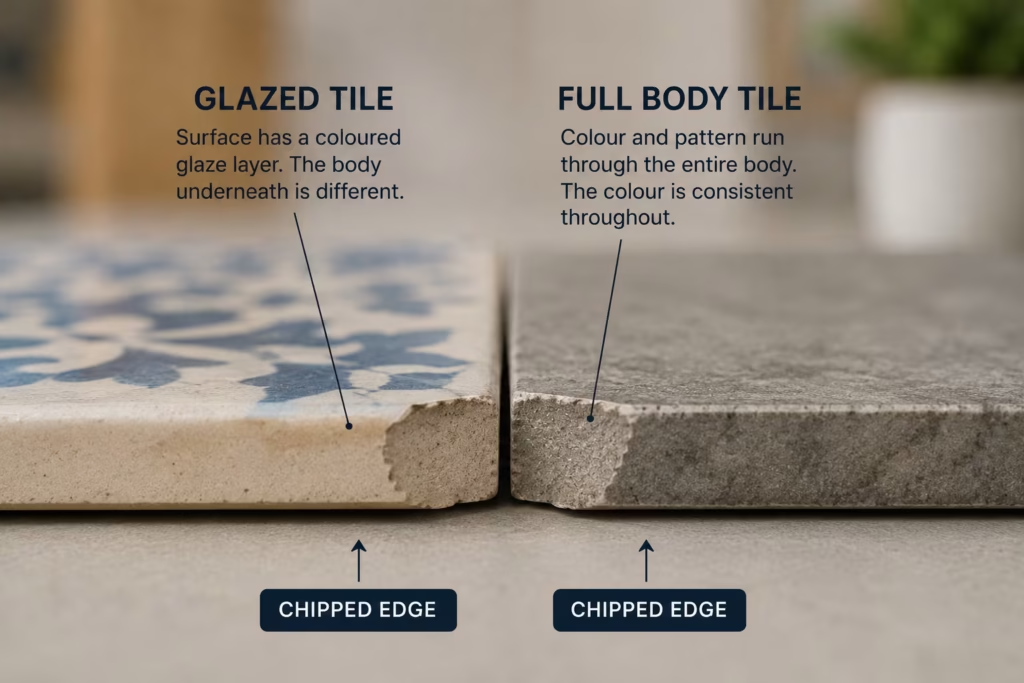
Here’s why it matters in real life: chip the corner of a GVT tile and you’ll often see a paler patch where the plain body shows through. Chip a full body tile and the exposed spot is roughly the same colour as the surface, so the damage barely shows. Double charge sits in between.
What are vitrified tiles, quickly?
All three are vitrified tiles first. Vitrified simply means the tile is fired at very high temperature into a dense, low-porosity body that barely absorbs water — which is why these tiles are the default for Indian homes over plain ceramic. If you want the fuller picture, see vitrified vs ceramic tiles.
So GVT, double charge and full body aren’t three different materials. They’re three ways of putting the design into a vitrified tile.
GVT: the one you buy for looks
GVT stands for Glazed Vitrified Tile. A vitrified body, with a digitally printed design sealed under a glaze on top.
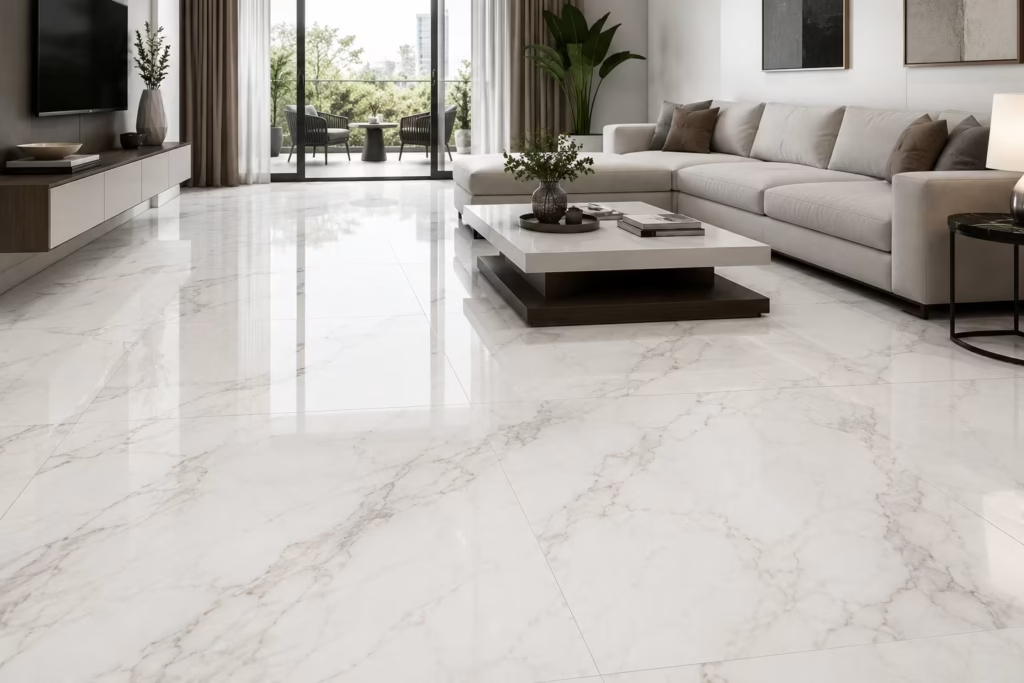
That printing is the magic. Modern digital printers can copy Italian marble veining, wood grain, weathered concrete, terrazzo, natural stone — the detail is genuinely close to the real thing. If you’ve seen a “marble look” floor that made you do a double take, it was almost certainly a good PGVT.
Where GVT shines: living rooms, bedrooms, dining rooms, feature walls, and any space where the look is the priority. It also comes in the widest range of finishes — matte, gloss, sugar, carving, textured — and the finish matters as much as the pattern.
The catch: the design lives near the surface. In normal home use that’s a non-issue for decades. But in heavy abrasion or where edges take knocks, severe wear can eventually reach the plain body underneath. And a high-gloss GVT that looks stunning in the showroom can be a slip risk on a wet bathroom floor. Don’t pick GVT on the pattern alone — match the finish and thickness to the room.
Double charge: the workhorse for busy floors
Double charge tiles are pressed with a much thicker layer of colour and pigment on top — commonly cited around 3–4 mm — rather than a thin printed glaze. So as the surface takes years of footfall, the visible design doesn’t wear away as quickly.
That’s why you see double charge in shopping areas, hotel lobbies, offices, showrooms, corridors and busy passages at home. It’s the practical middle ground: tougher underfoot than most decorative GVT, without jumping all the way to a full-body price.
The trade-off is design. The pressing process can’t reproduce the fine marble-and-wood realism that digital printing gives GVT. Colours and patterns are simpler and more industrial.
And a point people constantly get wrong — double charge is not full body. That thick colour layer still sits on a plain body. Cut the tile and the exposed edge can be a different shade underneath. Fine when skirting hides the edges. Worth knowing when they won’t.
Full body: colour all the way through
In a full body tile, the pigment is mixed through the entire body. The surface and the core are the same material and (broadly) the same colour.
This is the tile you specify when edges will be seen and life will be rough — staircases and nosings, parking areas, outdoor floors, heavy commercial corridors, façades. Chip it, cut it, grind it down over years, and it stays visually consistent because there’s no “hidden” plain layer to reveal.
The downsides are honest ones. Design range is narrower than GVT — full body leans toward textures and stone-inspired looks rather than ultra-detailed prints. It usually costs more, because more of the tile has to carry the pigment. And “full body” doesn’t mean unbreakable: a bad substrate or poor installation will still crack it, same as any tile.
Buying full body for a normal bedroom, just because it’s “the strong one,” is often paying for durability you’ll never use.
The three head-to-heads, settled
GVT vs Double Charge — this is design vs indoor toughness. Styling a living room? GVT gives you the freedom. Flooring a busy office or shop where wear is the worry? Double charge earns its keep.
Double Charge vs Full Body — same durability instinct, different depth. Both handle traffic well. Full body pulls ahead only where edges are exposed or abrasion is severe. If the edges are tucked under skirting, double charge is usually enough — and cheaper.
GVT vs Full Body — pure looks vs pure endurance. For a normal room, a well-specced GVT does everything you need and looks better doing it. Save full body for the demanding, edge-exposed, outdoor jobs.
The pattern you’ve probably spotted: it’s never “which is strongest?” It’s “which is right for this spot?”
Room by room: the short answer
Rather than repeat the same advice ten times, here’s the whole house on one screen. Note how often the finish — not the tile type — is the deciding factor.
| Where | Best pick | Why |
|---|---|---|
| Living room | GVT | Design range and finishes matter most; traffic is normal |
| Bedroom | GVT | Comfort and looks over heavy-duty wear |
| Kitchen | GVT with a matte/textured finish | Slip and stain resistance beat gloss here |
| Bathroom | Matte/anti-skid GVT (or full body) | Slip resistance comes first, full stop |
| Balcony / outdoor | Full body, textured/anti-skid | Weather and grip; verify outdoor rating |
| Staircase | Full body | Exposed edges and nosings take knocks |
| Parking | Full body, heavy-duty spec | Loads, abrasion, outdoor exposure |
| Shop / office / lobby | Double charge | High indoor footfall, edges usually hidden |
Two rules sit behind that whole table. In wet rooms, slip resistance decides before anything else — see best tiles for bathroom floor for the finishes to look for. And wherever a cut edge stays visible, full body has a real, not imaginary, advantage.
The mistakes that cost people money
Choosing by the showroom alone. A tile can look perfect on a vertical display and be wrong on a wet bathroom floor. The display isn’t the test — the room is.
Thinking full body means indestructible. It resists edge damage beautifully. It does not survive a moving substrate or a botched installation. Most “tile problems” are really installation problems — see why tiles pop up.
Gloss in wet areas. A glossy tile and a safe wet floor are two different things. Beautiful and slippery often go together.
Assuming double charge is full body. It isn’t. Deeper colour layer, yes. Colour all the way through, no.
Ignoring the install. Uneven floor, wrong adhesive, thin coverage, skipped expansion joints — any one of these can fail an expensive tile. Plan your quantities properly with the tile calculator before you order.
What about price?
There’s no fixed price per category, and anyone who quotes you one is guessing. The real number depends on brand, size, thickness, finish, design and where you’re buying.
As a rough positioning: GVT spans the widest range, from budget prints to premium large-format designer pieces. Double charge usually sits mid to premium for flooring. Full body tends toward the premium end, because the extra pigment through the body costs more to produce. The ranges overlap a lot, so compare actual products — not the label on the box. Prices vary constantly, so treat this as direction, not gospel.
Bottom line
There’s no overall winner here, because each one is built to solve a different problem.
- GVT = style. Best when looks and design variety lead — most living rooms and bedrooms.
- Double charge = high-traffic durability. Best for busy indoor floors where edges stay hidden.
- Full body = full-depth durability. Best where edges show and conditions are harsh — stairs, outdoors, parking.
The simplest way to decide: figure out the room, the traffic, the finish, and whether the edges will show — in that order. Then ask the dealer for the actual technical spec, not just the category name.
The right tile isn’t the most expensive one. It’s the one whose build and finish match the spot you’re putting it in.
FAQ
Is GVT better than double charge? Not universally. GVT wins on design and finish variety; double charge wins on wear resistance for busy indoor floors. It depends entirely on the room.
Which is the strongest — GVT, double charge or full body? The category name alone doesn’t decide it. Full body is generally strongest where edges are exposed and use is heavy, thanks to its through-body colour. Double charge is excellent for high-traffic indoor floors. Always check the actual abrasion and breaking-strength spec.
Is full body worth the extra cost for a home? Usually only for staircases, balconies, parking or outdoor areas — spots where edges show or conditions are rough. For a normal bedroom or living room, a good GVT does the job and looks better.
Which tile is best for a bathroom? Prioritise slip resistance over everything. A matte or textured, anti-skid-rated tile — GVT or full body — is far safer than a glossy surface, however good the gloss looks.
Are double charge tiles outdated? No. They’re still a strong choice for high-traffic flooring where wear resistance matters. Their design range is simply narrower than modern digitally printed GVT.
Can GVT be used on walls? Yes, GVT is widely used for decorative wall applications. Just confirm the specific product is intended for wall use.
Do full body tiles come in modern designs? Yes, but the look is different from GVT. Full body leans toward textured, stone-inspired and solid-colour finishes rather than ultra-detailed marble or wood prints.
Related Yashika Home guides
Planning a tile project? These will help:
- Tile calculator — work out how many tiles your room needs
- Tile adhesive calculator — estimate adhesive before you buy
- Vitrified vs ceramic tiles — the difference before you even pick a type
- Best tiles for bathroom floor — finishes that stay safe when wet
- Why tiles pop up — the installation mistakes that ruin good tiles
For more straight-talking guides on tiles, marble, granite and measurements, explore the rest of Yashika Home.
Editor’s note: tile terminology, construction and prices vary between manufacturers. Terms like “double charge” and “full body” should be verified against the manufacturer’s technical documentation before purchase. Never pick a tile on category name or showroom looks alone.
