
The honest answer: measure the floor, add a bit for cuts and breakages, then divide by the size of one tile. That’s the whole method in one line.
But there’s a right way and a wrong way to do each of those steps — and getting it wrong is how people end up either two tiles short on the last row, or with four spare boxes taking up space in the garage for the next decade.
So let’s do it properly. By the end of this, you’ll be able to work out how many tiles you need for any room, floor or wall, in either feet or metres.
If you just want the number fast, drop your measurements into the tile calculator and it does all of this for you. If you’d rather understand the maths first (recommended — it saves you money), read on.
The quick formula
Here’s the version to keep in your head:
(Room area × 1.1) ÷ area of one tile = number of tiles
That 1.1 is your 10% wastage. We’ll talk about when 10% isn’t enough in a minute.

Step 1: Measure the room
Grab a tape measure and get the length and the width of the floor. Multiply them together, and you’ve got your area.
- In feet: length (ft) × width (ft) = square feet
- In metres: length (m) × width (m) = square metres
A 12 ft × 10 ft room is 120 square feet. A 4 m × 3 m room is 12 square metres. Simple enough.
Two things trip people up here.
Odd-shaped rooms. If the room isn’t a clean rectangle, split it into rectangles in your head. Measure each block, work out its area, then add them together. An L-shaped room is just two rectangles pretending to be one.
Pick one unit and stick with it. Don’t measure the length in feet and the width in metres. It sounds obvious, but mixed units are behind more ordering mistakes than anything else.
Write the total down. That’s your base area before we add anything.
Step 2: Add wastage
You never order the exact floor area. Ever.
Tiles get cut to fit edges. A few crack during handling or fixing. And you want a small stash of spares for the day one tile gets chipped and you need a match — because tile shades change from batch to batch, and the batch you bought today won’t be on the shelf in three years.
How much extra depends on how you’re laying them:
| Situation | Add this much |
|---|---|
| Simple straight lay, square/rectangular room | 10% |
| Diagonal lay | 15% |
| Herringbone or patterned lay | 15–20% |
| Large-format tiles (more waste per cut) | 12–15% |
| Room with lots of corners, alcoves or angles | 15% |
| Very large, simple, open floor | 8–10% |
For most normal jobs, 10% is the number. If your layout is fancy or your room is full of nooks, lean towards 15%.
So our 120 sq ft room at 10% becomes 132 sq ft. The 12 m² metric room becomes 13.2 m².
Step 3: Turn area into tiles
Now divide your total area by the area of a single tile.
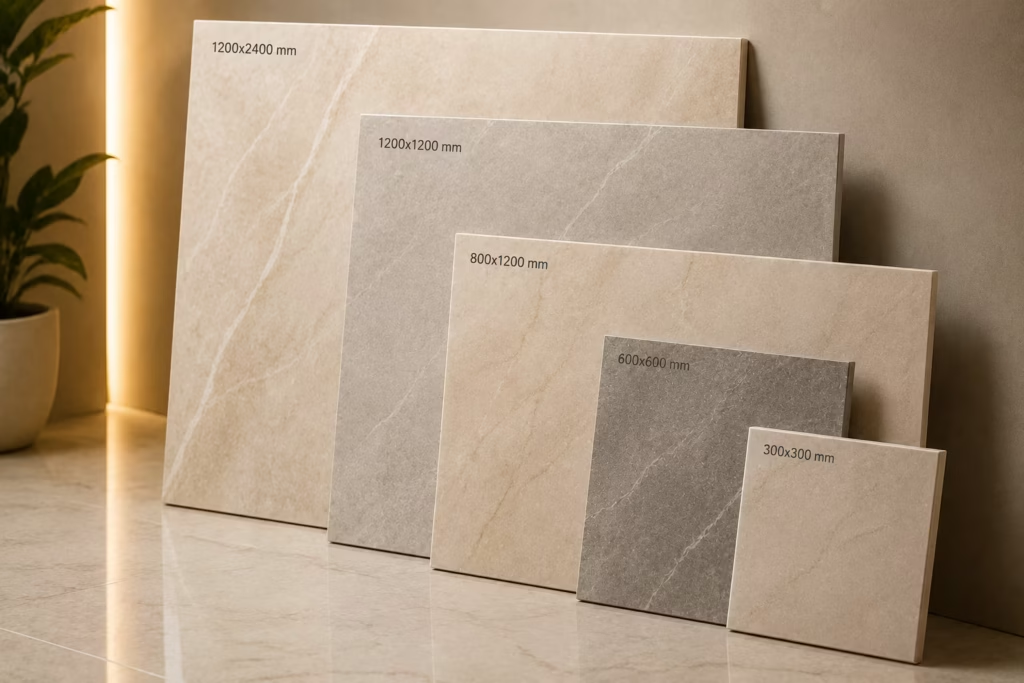
The catch is that tile sizes vary enormously, and a bigger tile means fewer tiles for the same floor. To save you the maths, here’s how many tiles cover a given area at common sizes.
Tiles per 100 square feet
| Tile size | Roughly this many per 100 sq ft |
|---|---|
| 8″ × 8″ | 225 |
| 12″ × 12″ | 100 |
| 16″ × 16″ | 56 |
| 12″ × 24″ | 50 |
| 24″ × 24″ | 25 |
| 24″ × 48″ | 13 |
Tiles per square metre
| Tile size | Roughly this many per m² |
|---|---|
| 200 × 200 mm | 25 |
| 300 × 300 mm | 11 |
| 300 × 600 mm | 5.6 |
| 600 × 600 mm | 2.8 |
| 800 × 800 mm | 1.6 |
| 600 × 1200 mm | 1.4 |
These are tile-only figures. They don’t count the grout gap, which slightly reduces how many you need — but that difference is tiny, and it’s safer to let it fall into your wastage buffer than to shave the order down.
A couple of worked examples
Numbers make it click, so let’s run two.
Example 1 — a bedroom floor, in feet
- Room: 12 ft × 10 ft = 120 sq ft
- Add 10% wastage → 132 sq ft
- Tiles: 24″ × 24″ (each covers 4 sq ft)
- 132 ÷ 4 = 33 tiles
Example 2 — a living room floor, in metres
- Room: 4 m × 3 m = 12 m²
- Add 10% wastage → 13.2 m²
- Tiles: 600 × 600 mm (2.8 per m²)
- 13.2 × 2.8 = 36.96 → 37 tiles
Notice we rounded up both times. Always round up. A part-tile still means buying a whole tile.
Ordering by the box, not the tile
Here’s where a lot of people slip. Tiles are sold in boxes, and you can’t buy half a box. So once you know your tile count, you round up to full boxes.
The number of tiles in a box changes with the tile size — big tiles come fewer to a box, small ones come many. We’ve broken down the exact counts for how many tiles are in a box, which is worth a look before you place the order.
The quick way: find how much area one box covers, then divide your total area by that.
- Total area needed (with wastage) ÷ area covered per box = number of boxes
- Round up to the next whole box
If a box of your chosen tile covers 16 sq ft, then our 132 sq ft job needs 132 ÷ 16 = 8.25 → 9 boxes.
Buy all your boxes in one go, and where you can, check that they’re from the same batch or shade lot. Mixing lots is how you end up with a patch of floor that’s a shade off under certain light.
Walls are measured differently
Everything above is for floors. Walls follow the same logic with two twists.
Measure each wall as height × width, then add the walls together. A bathroom being tiled to the ceiling on all four walls is just four rectangles.
Subtract the big openings — sometimes. A large window or a doorway that won’t be tiled can be deducted from your area. But only knock off the genuinely large gaps. Leave small ones in; they get eaten by cuts and give you useful spares. When in doubt, don’t subtract — running short on a wall is far more annoying than having a couple of tiles left over.
Wastage on walls runs the same as floors: 10% for a straight lay, more for patterns.
The mistakes that cost people money
A few things I see again and again:
- Skipping wastage. Ordering the exact floor area and hoping for the best. You will run short.
- Rounding down. “It’s basically 8 boxes.” No — it’s 9.
- Buying batches separately. Topping up later with a different shade lot that no longer matches.
- Mixing units mid-measurement.
- Forgetting the spares. Keep three or four leftover tiles after the job. Future-you will be grateful when something cracks.
None of these are hard to avoid. They just need a moment of care before you order.
Bottom line
Measure the floor, add 10% for a normal straight lay (15% for diagonal or patterned work), then divide by the area of one tile — and round up to whole boxes.
That’s it. The wastage buffer is the part people skip and the part that matters most, so don’t trim it to save a box. A spare tile in the garage is cheap insurance; a half-finished floor waiting on a new order is not.
And if you’d rather skip the arithmetic entirely, the tile calculator takes your room size and tile size and hands you the tile and box count in seconds.
FAQ
How many tiles do I need for a 10×10 room? A 10 ft × 10 ft room is 100 sq ft. Add 10% wastage for 110 sq ft. With 12″ × 12″ tiles that’s about 110 tiles; with 24″ × 24″ tiles it’s about 28. Divide by your tile size and round up.
How much wastage should I add for tiles? Add 10% for a standard straight lay in a simple room. Go to 15% for diagonal, herringbone or patterned layouts, and for rooms with lots of corners and cuts.
Do I include wastage when ordering, or buy it separately? Include it in the single order. Buying spares later risks a different shade batch that won’t match your floor.
How do I calculate tiles for an L-shaped room? Split the room into two rectangles, work out the area of each, add them together, then apply the same wastage and tile-size maths as a normal room.
How many tiles do I need per square metre? It depends on tile size. Roughly 11 tiles per m² for 300 × 300 mm, about 2.8 per m² for 600 × 600 mm. See the coverage table above for other sizes.
Should I subtract doors and windows when tiling a wall? Only deduct large openings like a big window or a doorway. Leave small gaps in — they get absorbed by cuts and give you handy spares.
Why do I need to keep spare tiles after the job? Tile shades vary between production batches. If a tile chips years later, a spare from your original batch is the only reliable colour match.
Is it better to order by tile count or by box? Work out your tile count first, but order by the box — you can’t buy part of a box. Round your box count up to the next whole number.
