
How many tiles are in one box?
It sounds like it should have a simple answer — but if you’ve ever stood in front of a shelf of tile trying to work out how much to buy, you’ve probably discovered it doesn’t. One box might hold four large floor tiles; another might hold forty small wall tiles. Both are “one box,” yet they cover completely different amounts of wall or floor.
The truth is there is no single, universal number of tiles per box — and once you understand why, buying the right amount becomes easy. This guide explains exactly what decides how many tiles come in a box, gives you a reference table of typical quantities by size, and — most importantly — shows you the one number that actually matters when you’re ordering: coverage. By the end, you’ll know how to work out precisely how many boxes your project needs, without over-buying or coming up short.
The honest answer: there’s no fixed number
Let’s clear this up first, because it saves a lot of confusion. The number of tiles in a box is not standardised. It changes from size to size, material to material, and even from one manufacturer to another for tiles that look identical.
Here’s the logic behind it: manufacturers don’t pack a fixed count of tiles into every box. Instead, they pack each box to hold a manageable, sensible amount of coverage and weight. A box needs to be liftable and shippable, so a box of big, heavy floor tiles will hold only a few pieces, while a box of small, light wall tiles will hold many. The count follows from the size and weight — not the other way around.
So a box of large 600×600 mm (24×24 inch) floor tiles typically holds just 4 pieces, while a box of small 3×6 inch subway tiles can hold 40 or more. Both are perfectly normal. Asking “how many tiles are in a box?” without saying which tile is a bit like asking “how many fit in a bag?” — it depends entirely on what you’re putting in it.
This is why the real skill isn’t memorising piece counts. It’s learning to read the one figure that lets you buy correctly every time: the coverage per box. We’ll get to that — but first, let’s look at what actually drives the count.
What decides how many tiles are in a box?
Four main factors determine how many tiles a manufacturer puts in each box.
1. Tile size
This is the biggest factor by far. The larger each tile, the fewer fit in a box; the smaller each tile, the more fit. It’s simple space: a box can only hold so much area, so bigger tiles mean fewer pieces. A single 600×600 mm tile takes up the space of nine 200×200 mm tiles, so naturally far fewer of the big ones fit per box.
2. Tile thickness
Thickness matters as much as surface size. Thicker, heavier tiles — like floor tiles, outdoor paving, or step tiles — take up more volume and add more weight, so fewer are packed per box to keep it liftable. Two tiles with the same face size but different thicknesses can come in different quantities per box for exactly this reason.
3. Material
What the tile is made of affects both weight and fragility, which affects packing. Dense porcelain and natural stone (marble, granite) are heavy, so boxes hold fewer pieces to stay within a safe weight. Natural stone is also more fragile and valuable, so it’s often packed in smaller, better-protected quantities. Lighter ceramic wall tiles can be packed in greater numbers.
4. The manufacturer
Finally, there’s no industry rule forcing every brand to pack the same. Two manufacturers can sell the “same” 300×300 mm tile and pack them differently — one might put 10 in a box, another 11. This is exactly why you should never rely on a remembered number and should always check the specific box you’re buying.
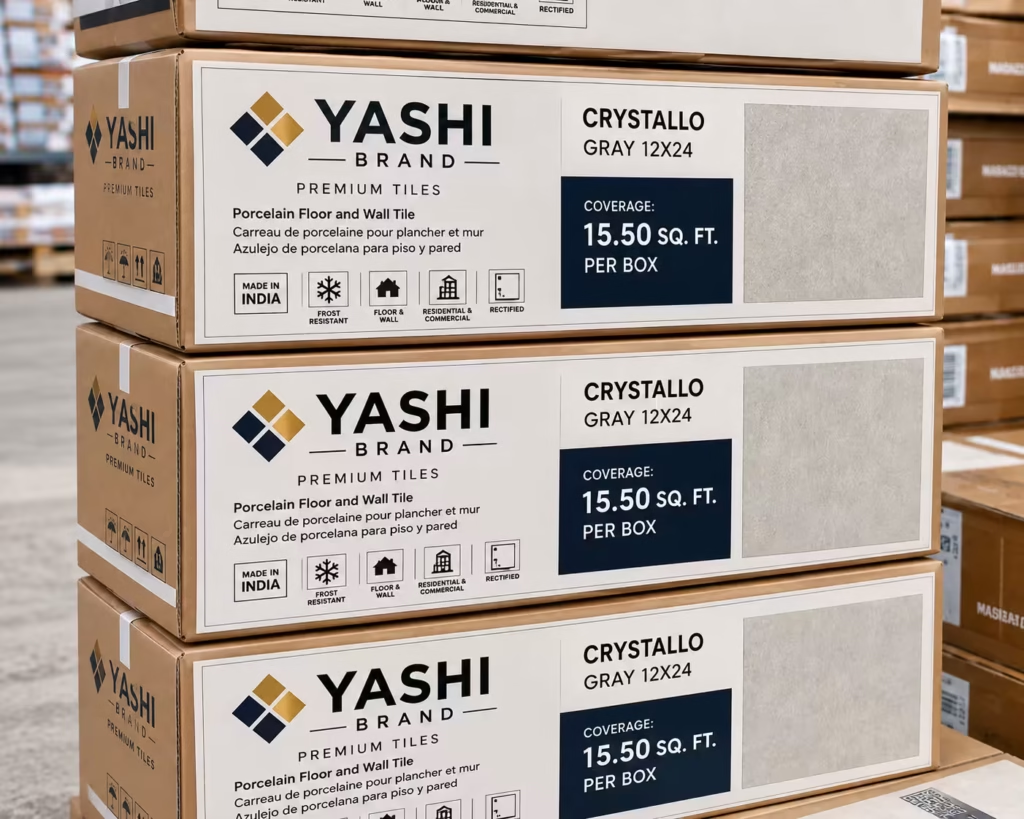
Typical tiles per box by size
With all those variables, it helps to have a realistic reference. The table below shows typical quantities and coverage for common tile sizes. Treat these as ballpark figures — your actual box may differ, so always confirm on the label.
| Tile size | Typical pieces per box | Approx. coverage per box |
|---|---|---|
| 3×6 in (75×150 mm) subway | 40–48 | 5–10 sq ft |
| 100×100 mm (4×4 in) | 20–30 | 3–5 sq ft |
| 200×200 mm (8×8 in) | 15–17 | 5–7 sq ft |
| 250×400 mm (10×16 in) wall | 8–10 | 10–12 sq ft |
| 300×300 mm (12×12 in) | 10–15 | 11–15 sq ft |
| 300×600 mm (12×24 in) | 5–8 | 15–16 sq ft |
| 600×600 mm (24×24 in) | 3–4 | 12–16 sq ft |
| 600×1200 mm (24×48 in) | 2–3 | 15–16 sq ft |
| 800×800 mm (32×32 in) | 3 | ~17 sq ft |
| Wood-look plank (150×600–900 mm) | 8–12 | ~12 sq ft |
| 600×1200 mm+ large format | 2 | varies |
Notice something important in that table: the piece counts vary wildly, but the coverage per box clusters in a much tighter range — usually somewhere between about 8 and 16 square feet. That’s not a coincidence, and it points to the key insight of this whole guide.
Why coverage matters more than piece count
Here’s the shift that makes tile-buying simple: stop counting tiles, and start counting coverage.
Tiles are sold by the box, but what you’re really buying is area — enough tiles to cover a certain number of square feet or square metres. Every box states this figure, printed clearly on the label as “coverage per box” (in sq ft and/or sq m). This is the number that matters, because:
- It’s what you compare against your room’s area
- It already accounts for the piece count and tile size for you
- It lets you compare different tiles fairly, regardless of how many pieces are in each box
Two boxes might contain very different numbers of tiles — say 4 large tiles versus 12 medium tiles — yet both cover a similar area. When you buy by coverage, those differences stop mattering. You simply ask: how many square feet does one box cover, and how many square feet do I need?
So the golden rule is this: ignore the piece count when ordering, and use the coverage per box instead. The piece count is useful only for a sanity check when the box arrives.
How to work out how many boxes you need
Once you’re thinking in coverage, calculating your order is straightforward. Here’s the method.
Step 1 — Measure your area. Multiply the length by the width of your floor or wall to get the total area. For several walls or areas, work them out separately and add them up.
Step 2 — Add a waste allowance. You always need slightly more tile than the bare area, because tiles are cut at edges and corners and some break. Add a percentage on top (more on how much below).
Step 3 — Check the coverage per box. Read the “coverage per box” figure on the tile you’ve chosen.
Step 4 — Divide and round up. Divide your total area (including waste) by the coverage per box, then round up to the next whole box — because you can’t buy part of a box.
The formula:
Boxes needed = (area + waste) ÷ coverage per box, rounded up
A worked example. Say your room is 12 ft × 10 ft = 120 sq ft. You add 10% waste, giving 132 sq ft. Your chosen tile covers 16 sq ft per box. So: 132 ÷ 16 = 8.25 boxes → round up to 9 boxes. Simple.
A second example with small tiles. A backsplash area of 30 sq ft, with subway tiles covering 6 sq ft per box, plus 10% waste (33 sq ft): 33 ÷ 6 = 5.5 → 6 boxes. Notice you never needed to know that each box holds 40-odd tiles — the coverage did all the work.
If you’d rather not do the maths by hand, our free tile calculator does exactly this: enter your area, your tile’s coverage (or size), and your waste percentage, and it tells you how many boxes to buy.
How much waste should you add?
The waste allowance isn’t padding — it’s the tile lost to cutting, breakage, and future repairs. How much you add depends mainly on your layout, because more complex patterns force more angled cuts and offcuts.
| Layout / situation | Suggested waste allowance |
|---|---|
| Straight lay, simple rectangular room | 5–10% |
| Running bond / offset (e.g. brick, subway) | 10–12% |
| Diagonal layout | 15% |
| Herringbone / chevron | 15–18% |
| Mosaics or heavy pattern-matching | 15–20% |
| Rooms with many corners, cutouts, curves | Add a little extra on top |
A good default for a normal straight-laid floor is 10%. Increase it for diagonal, herringbone, or mosaic work, and for rooms with lots of obstacles to cut around.
One more reason not to skimp on the allowance: it’s far better to have a spare box than to run out mid-job and have to order more — which brings us to dye lots.
Always buy a spare box (the dye-lot reason)
Here’s a tip that saves real heartache: buy at least one extra box, and make sure all your tile comes from the same batch.
Tiles are made in production runs, and the exact shade can vary slightly from one run — or “dye lot” — to another. Tiles from the same batch are shade-matched; tiles from a different batch may be subtly but noticeably different in colour or tone. If you run short and have to buy more later, there’s a real chance the new box comes from a different lot and doesn’t quite match, leaving a visible patch.
So two habits protect you:
- Order from the same batch — check that all boxes share the same batch or shade code.
- Keep a spare box — after the job, store a leftover box from that batch. If a tile ever cracks or you extend the area, you’ll have a perfect match.
This is also why the waste allowance and the spare box go hand in hand: buying slightly over means you finish the job from one matched batch, with a little left for the future.
Practical tips for buying tiles by the box
A few final pointers to make your purchase smooth:
- Read the label, not your memory. The coverage and piece count are printed on every box — trust that, not a general figure.
- Confirm the coverage before you calculate. It’s the number your whole order depends on.
- Check nominal vs actual size. Listed (“nominal”) sizes are sometimes slightly larger than the true tile, which is normal and already reflected in the coverage figure.
- Inspect boxes on delivery. Check a box’s piece count and look for breakages; occasional packing errors happen.
- Buy walls and floors separately. They often use different tiles with different coverage — calculate each on its own.
- For big or multi-room jobs, ask about boxes-per-pallet if you’re buying in bulk, and always confirm batch consistency across the whole order.
The bottom line
So, how many tiles are in one box? The honest answer is: it depends — on the tile’s size, thickness, material, and manufacturer. A box might hold anywhere from two large-format tiles to fifty small subway tiles, and both are completely normal.
But here’s the freeing part: you don’t actually need to know the piece count to buy the right amount. What you need is the coverage per box — the square feet or square metres one box covers — which every manufacturer prints on the label. Measure your area, add a sensible waste allowance, divide by the coverage per box, round up, and add a spare box from the same batch. Do that, and you’ll buy exactly what your project needs, every time — no shortfall, no wasted money.
And if you’d like the maths done for you, our free tile calculator turns your measurements and box coverage into the exact number of boxes to buy.
Frequently asked questions
How many tiles are in one box? There’s no fixed number — it depends on the tile’s size, thickness and material. As a rough guide, large 600×600 mm floor tiles come about 3–4 per box, 300×300 mm tiles about 10–15, and small 3×6 inch subway tiles around 40–48. Always check the box label for the exact figure.
How many 600×600 tiles are in a box? Typically 3 to 4 pieces, covering roughly 12–16 square feet per box — though this varies by brand and thickness, so confirm on the label.
How many 12×12 inch tiles come in a box? Usually around 10 to 15 pieces, covering about 11–15 square feet, depending on the manufacturer.
Why do different boxes have different numbers of tiles? Because boxes are packed to a sensible weight and coverage, not a fixed count. Bigger, heavier, or thicker tiles mean fewer pieces per box; smaller, lighter tiles mean more. Manufacturers also pack differently from one another.
Should I count tiles or coverage when buying? Coverage. Tiles are sold by the box, but what matters is the area each box covers (its “coverage per box”). Divide your total area plus waste by the coverage per box to find how many boxes to buy.
How many boxes of tile do I need? Measure your area, add a waste allowance (about 10% for a simple layout, more for diagonal or mosaic patterns), then divide by the coverage per box and round up. Our tile calculator does this for you.
Should I buy extra tiles? Yes. Always buy at least one spare box from the same batch, both to cover cutting and breakage and to have a shade-matched tile for future repairs, since colour can vary between production batches.
