
Most tile falls happen in the same spot: a wet bathroom floor, first thing in the morning, bare feet.
Anti-slip tiles (also called anti-skid tiles) are made to stop exactly that. They’re not a gimmick and they’re not just “rough tiles” — there’s a real, tested science behind how much grip a tile gives when it’s wet, greasy, or walked on in socks.
The tricky part is that almost every tile in a showroom gets labelled “anti-slip” these days, whether it deserves it or not. So this guide cuts through it: what the grip ratings actually mean, how much grip you need in each room, and — honestly — where anti-slip tiles are worth it and where they just make your life harder.
What “anti-slip” actually means
Grip comes from texture. A polished tile is smooth at a microscopic level, so when water sits on top, your foot glides across a thin film — that’s the slip. An anti-slip tile has a slightly rougher, more structured surface. Those tiny peaks and valleys break through the water and give your foot something to catch on.
Here’s the thing most people get wrong: slip resistance isn’t a yes-or-no feature. It’s a scale. A tile isn’t simply “anti-slip” or “not” — it sits somewhere on a range from glassy-smooth to industrial-grip. The whole game is matching the right point on that scale to the right room.
And more grip isn’t automatically better. The rougher a tile gets, the more dirt it traps and the less pleasant it feels underfoot. We’ll come back to that trade-off, because it matters more than the brochures admit.

How slip resistance is measured
There are a few different tests used around the world, and it helps to know the main ones so you can read a spec sheet properly instead of trusting the word “anti-slip” on a sticker.
R-ratings (R9 to R13) — the ramp test
This is the most common system you’ll see, and it comes from a German standard called DIN 51130.
The test is refreshingly literal. A person puts on standard work boots, the tile is coated in oil, and they walk up and down a ramp that slowly tilts steeper and steeper. The angle at which they start to slip decides the rating. Steeper before slipping means more grip.
| R-rating | Slip angle | Grip level | Typical use |
|---|---|---|---|
| R9 | 6°–10° | Lowest | Dry indoor areas — living rooms, bedrooms |
| R10 | 10°–19° | Moderate | Bathrooms, kitchens, entrances (occasional water) |
| R11 | 19°–27° | Good | Showers, balconies, covered outdoor areas |
| R12 | 27°–35° | High | Very wet or greasy commercial floors |
| R13 | >35° | Highest | Industrial kitchens, workshops, wash-down areas |
One catch worth knowing: R9 still carries an “R,” so it gets sold as anti-slip. But it’s the bottom of the scale. For anything that gets wet regularly, R10 is really the sensible starting point, not R9.
DCOF — the number to look for
In the US and increasingly worldwide, you’ll see a figure called DCOF (Dynamic Coefficient of Friction), set out in the ANSI A137.1 / A326.3 standards. It measures friction on a wet surface while walking, not just standing still.
The number to remember is 0.42. A tile with a wet DCOF of 0.42 or higher is considered suitable for a level indoor floor that’s expected to get wet. Below that, you’re into risky territory for wet areas.
For genuinely wet zones — showers, pool decks, entries that see rain — many specifiers push for higher, around 0.50 to 0.60, because the baseline is a minimum, not a promise. Even the standard itself is clear that 0.42 is a comparison benchmark, not a guarantee that nobody will ever slip.
Barefoot ratings (A, B, C)
The R-rating test is done in shoes. But bathrooms and pools are barefoot places, and bare skin grips differently from a boot sole. So there’s a separate barefoot ramp test (DIN 51097) that gives an A, B or C rating.
- A — minimal wet, barefoot areas
- B — shower floors and pool surrounds
- C — steep, constantly wet areas like the ramp into a pool
If you’re picking tiles for a walk-in shower or a wet room, a barefoot B rating tells you far more than a shod R-rating does. It’s the one to ask for.
PTV — the pendulum test
In the UK, Australia and some other markets, slip resistance is measured with a pendulum (BS 7976) that gives a Pendulum Test Value, or PTV. A PTV of 36 or above is generally treated as low slip risk.
A quick honest note: these systems don’t convert neatly into each other. An R-rating won’t reliably tell you a tile’s exact PTV, and vice versa. If a supplier only quotes one, don’t let them “translate” it into another to make a tile sound safer than it’s been tested to be.
Which grip level do you actually need?
You don’t need the same tile everywhere. Over-speccing grip is a real and common mistake — people put near-industrial texture in a family bathroom and then spend years scrubbing grime out of it.
Here’s a sensible room-by-room guide:
| Space | Suggested grip | Why |
|---|---|---|
| Living room, bedroom | R9 | Dry, low risk — comfort and looks win here |
| Kitchen floor | R10–R11 | Splashes, spills, the occasional oil drop |
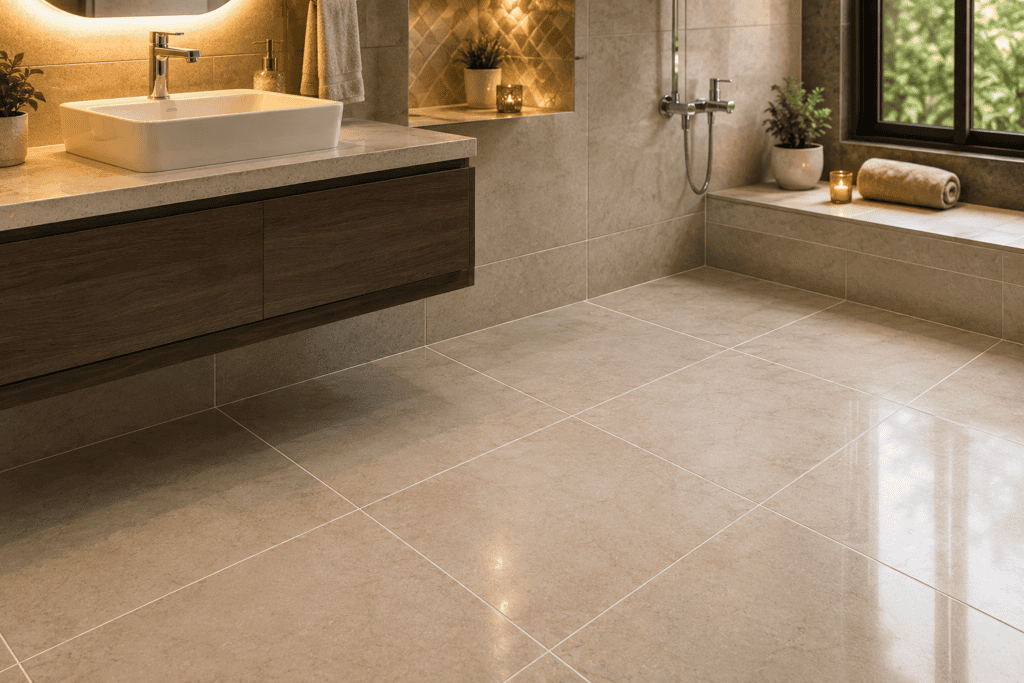
| Bathroom floor | R10–R11 | Wet feet, water on the floor daily |
| Shower / wet room | R11 + barefoot B | Constant water, bare feet, worst-case combo |
| Entryway / mudroom | R10–R11 | Rain and dirt tracked in from outside |
| Balcony / patio | R11 | Exposed to rain, sometimes on a slight slope |
| Poolside | R11–R12 + barefoot B/C | Wet, barefoot, and people move fast |
| Ramps, elderly-friendly homes | R11+ | Slopes and reduced mobility raise the stakes |
Treat this as a starting point, not gospel. A north-facing patio that stays damp, a home with young kids or older parents, a shower used by someone unsteady on their feet — all of these are good reasons to go one notch higher than the table suggests.
Where anti-slip tiles are genuinely worth it
Some spaces are non-negotiable. This is where I’d never cut the grip to save money or for a slightly prettier finish.
Bathrooms and showers. Bare feet plus standing water is the single most dangerous flooring combination in the home. This is the room to get right. If you’re weighing up materials and finishes for this space, our guide to the best tiles for bathroom floor goes deeper into what holds up long-term.
Kitchens. It’s not just water — it’s oil, grease and the odd dropped egg. A splash of cooking oil on a polished floor is genuinely dangerous. R10 or R11 earns its keep here.
Entryways and mudrooms. Rain, wet shoes and dirt all arrive at your front door together. The transition zone from outside to inside is a classic slip point.
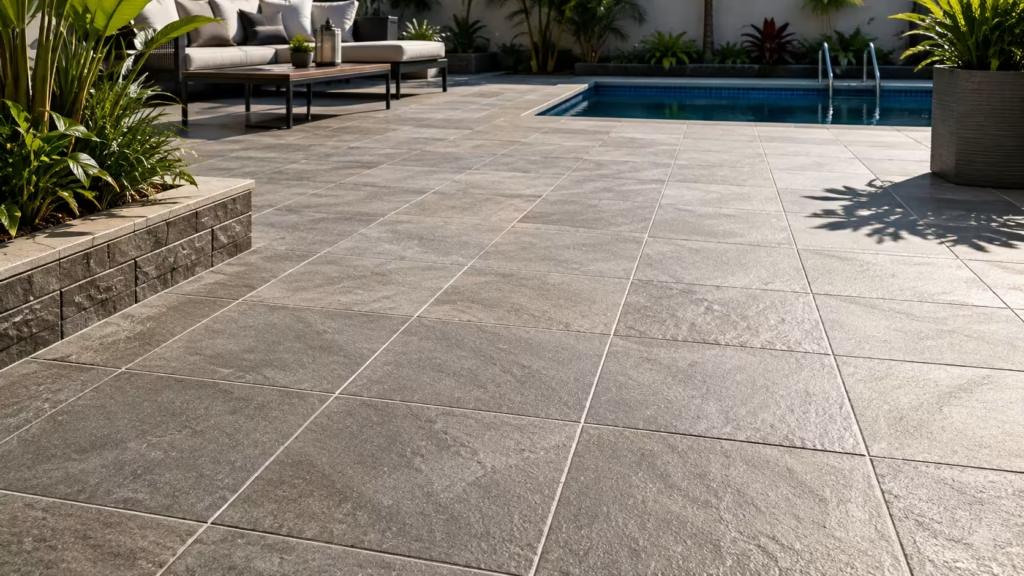
Outdoors — patios, steps and poolside. Anything exposed to rain needs real grip, and steps most of all, because a slip on a stair is far more serious than a slip on the flat. Poolside deserves the highest attention: wet, barefoot, and often children running.
Homes with older adults or reduced mobility. For someone unsteady on their feet, the right floor is a safety device. This is where going a grade higher is simply good sense.
Where you might not need them — and the honest trade-offs
Now the part the tile ads skip.
Grip has a cost, and it isn’t money — it’s maintenance and comfort.
A textured surface traps dirt. All those tiny peaks and valleys that catch your foot also catch grime, soap scum and grease. Higher-grip tiles are simply harder to clean, and they show buildup faster. In a shower, that texture is where scum and hard-water residue love to collect.
Very high grip is unpleasant barefoot. R12 and R13 are built for factory floors and commercial kitchens. Put that inside a home bathroom and it feels like sandpaper under bare feet, catches on mop heads, and looks industrial. It’s the wrong tool for the room.
Slip resistance fades over time. No tile stays as grippy as the day it was laid. Wear smooths the surface, and polish or soap residue can build a slick film on top. A floor that tested well when new can turn slippery years later if it’s cleaned with the wrong products or waxed. This is worth remembering: grip is partly about upkeep, not just the tile you buy.
So in dry, low-risk rooms — living rooms, bedrooms, dining areas — there’s no reason to chase a high rating. R9 is fine, cleaning is easier, and you keep the finishes you actually want, including a bit of shine if that’s your taste.
The goal isn’t maximum grip everywhere. It’s the right grip in the right room.
Anti-slip finishes and how grip is added
Not all anti-slip tiles are made the same way. A few things worth understanding before you buy:
Finish matters as much as material. As a rough rule, polished tiles have the least grip, matte or honed sit in the middle, and structured or textured finishes grip the most. A matte porcelain often lands around R10 — a comfortable middle ground for most homes.
Structured / grip finishes. Some porcelain is made with a deliberately textured face for wet and outdoor use. This is the real deal for patios and pool areas.
Anti-slip coatings and treatments. You can also buy treatments that etch or coat an existing floor to raise its grip. They work, but be realistic: they wear off, they can dull the tile’s look, and they need reapplying. They’re a fix for an existing slippery floor, not a substitute for choosing the right tile in the first place.
Smaller tiles give more grip. Here’s a trick the pros use: more grout lines mean more traction. Grout is textured, sits slightly recessed, and breaks up the smooth surface. That’s exactly why shower floors so often use small mosaic tiles — the grout does half the anti-slip work. The flip side is more grout to keep clean, which loops back to that maintenance trade-off.
What to check before you buy
A few habits that’ll save you grief:
Ask for the actual rating — the R-value, the DCOF, or the barefoot A/B/C — and don’t accept the word “anti-slip” on its own. A reputable supplier can show you the spec sheet. If they can’t produce a number, treat the claim with caution.
Match the rating to the room using the table above, then think about who uses the space and how wet it really gets.
Factor in cleaning. Be honest with yourself about how much scrubbing you’ll actually do, and don’t over-spec grip you’ll resent later.
And once you’ve settled on a tile and a room, work out how much you need before you order — running short mid-job or massively over-buying are both easy to avoid. Our tile calculator does the maths for you in a few seconds.
Bottom line
Anti-slip tiles are worth it exactly where slips actually happen — bathrooms, showers, kitchens, entryways, steps and anywhere outdoors that gets wet. In those rooms, don’t compromise.
Match the grip to the room. R9 for dry living spaces, R10–R11 for bathrooms and kitchens, R11 and a barefoot B rating for showers and wet rooms, and R11–R12 for poolside and outdoor steps. In the US, look for a wet DCOF of 0.42 or higher for any floor that gets wet.
But resist the urge to max out grip everywhere. More texture means more cleaning and less comfort underfoot, and a floor’s grip fades with wear and buildup anyway. The best floor isn’t the grippiest one — it’s the one that’s safe where it needs to be and easy to live with everywhere else.
FAQ
What is the difference between anti-slip and anti-skid tiles? There isn’t one — they’re two names for the same thing. “Anti-skid” is used more in India and parts of Asia, “anti-slip” more in the US, UK and Europe. Both describe a tile with a textured surface designed to give grip when wet.
What R-rating do I need for a bathroom floor? R10 is a solid minimum for a bathroom floor that dries between uses. For a walk-in shower or wet room where the floor stays wet, step up to R11 and look for a barefoot B rating too, since bathrooms are used barefoot.
Are anti-slip tiles harder to clean? Generally, yes. The texture that gives grip also traps dirt, soap scum and grease, so grippier tiles need a bit more scrubbing and show buildup faster. It’s the main trade-off — which is why you match the grip to the room rather than maxing it out everywhere.
Can I make my existing tiles less slippery without replacing them? Yes. Anti-slip treatments and coatings can raise the grip of a floor you already have. They do work, but they wear over time, may slightly dull the finish, and need reapplying. Good for a fix, not a replacement for choosing the right tile from the start.
Do anti-slip tiles work when they’re wet? That’s the whole point — they’re tested wet. The R-rating ramp test uses oil, and the DCOF test uses water, precisely because a dry floor is easy and a wet one is where falls happen. Just remember no tile is completely slip-proof, and grip drops if the surface is dirty or worn.
Are matte tiles automatically anti-slip? Not automatically, but they’re usually grippier than polished ones. Polished tiles tend to have the least grip, matte and honed sit in the middle, and structured finishes grip the most. Always check the actual rating rather than assuming from the finish alone.
Why do shower floors use small tiles? More grout lines mean more grip. Grout is textured and sits slightly lower than the tile face, so it breaks up the smooth surface and gives your feet extra traction. That’s why small mosaic tiles are so common on shower floors — the grout does part of the anti-slip work.
Is a higher R-rating always better? No. R12 and R13 are meant for industrial floors and feel harsh and unpleasant underfoot at home, plus they’re a chore to clean. For a house, R10–R11 covers almost every wet area comfortably. Over-speccing grip usually causes more problems than it solves.
