
Should you fix your tiles with traditional cement, or with modern tile adhesive? It’s the first real decision of any tiling job, and it quietly decides how long that floor or wall will last. For years, cement was the only option, and many masons still reach for it out of habit — but tiles have changed, and with today’s dense vitrified and large-format tiles, the old cement method often fails. This guide compares the two clearly, shows you a practical way to decide for your own job, and lists the leading adhesive brands in India.
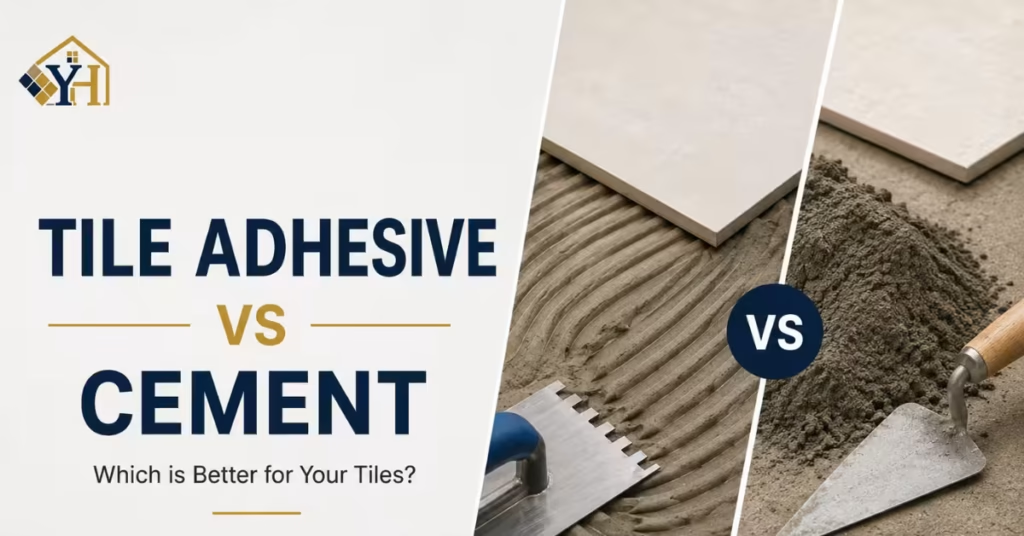
The quick answer
For most modern tiling — vitrified, porcelain, marble, granite, and large-format tiles — tile adhesive is the better choice. It bonds far more strongly, works in a thin even layer, and grips smooth, dense tiles that cement simply can’t hold. Cement mortar still works for porous, traditional ceramic tiles in dry areas and on a tight budget, but for anything modern or wet, adhesive wins on durability. The small extra cost is far cheaper than re-laying a floor that comes loose.
The difference in one line
Cement mortar is sand and cement mixed on site into a thick bed. Tile adhesive is a factory-made powder — cement, fine sand and polymers — mixed with water into a thin, smooth paste. That polymer content is the whole story: it’s what lets adhesive stick to a glass-smooth vitrified tile, where plain cement can’t get a grip.
Tile adhesive vs cement: comparison table
| Factor | Cement Mortar | Tile Adhesive |
|---|---|---|
| Bond strength | Moderate; relies on tile porosity | Very strong; polymer-modified grip |
| Works on vitrified / large tiles | Poor — can’t grip smooth backs | Excellent — made for them |
| Layer thickness | Thick bed (12–20 mm), heavy | Thin bed (3–6 mm), even |
| Consistency | Varies with sand & mason’s mix | Factory-made, same every batch |
| Finish / level | Harder to keep flat, esp. large tiles | Flatter, more uniform |
| Wet areas (bath, kitchen) | Weak over time | Strong; wet-area grades available |
| Wastage & mess | More material, more mess | Less material, cleaner |
| Upfront cost | Cheaper per sq ft | Higher per sq ft |
| Long-term value | Risk of hollow/loose tiles | Reliable, long-lasting bond |
Why modern tiles changed everything
Here’s the part many people miss. Old-style ceramic tiles were fairly porous on the back, so cement could soak in slightly and hold. But modern vitrified and porcelain tiles are dense and almost non-porous — their backs are smooth and absorb almost nothing, so traditional cement has nothing to grab onto. Lay a big vitrified tile on cement and, months later, it can lift, shift, or sound hollow when tapped. This is the single most common reason tiles fail, and it’s completely avoidable.
A note from behind the counter: this is exactly where I see customers go wrong. Many are in a hurry to lay tiles the moment they buy them, and want the mason to fix everything with cement the old way to save a little money and time. With today’s tiles, that’s a gamble. The customers who use proper adhesive almost never come back with a complaint; the ones who rush with cement sometimes do — and by then, lifting and re-laying is a far bigger, costlier job. A little more spent on adhesive at the start is the cheapest insurance a tiling job can have.
A practical way to decide
You don’t need to overthink it. Use this simple approach:
- Look at your tile. Is it vitrified, porcelain, marble, granite, or large-format (600×600 mm or bigger)? → Use adhesive. Is it small, porous, traditional ceramic in a dry room? → Cement can work, but adhesive is still safer.
- Look at the location. Bathroom, kitchen, balcony, outdoor, or any wet area? → Use adhesive (a wet-area grade).
- Check the surface. If the base is uneven, don’t try to fix it with a thick cement bed — level it first with a levelling compound, then lay tiles with adhesive.
- Tell your mason clearly. Ask for tiles to be fixed with the correct tile adhesive, not site-mixed cement — and confirm the adhesive type suits your tile (more on types below). A good mason will agree; it makes their work last and look better too.
Simple rule: if you’re spending real money on modern tiles, don’t save a few rupees on how they’re stuck down. Adhesive protects the investment.
How much adhesive will you need?
One reason people hesitate on adhesive is not knowing how much to buy. It’s simpler than it looks — adhesive is measured in kilograms per square metre, mostly depending on tile size, and comes in 20 kg bags in India. Rather than guess, work out exactly how many bags your job needs with our tile adhesive calculator — enter your area and tile type and it gives you the bag count, so switching to adhesive doesn’t mean overspending.
Leading tile adhesive brands in India
If you go with adhesive, you’ll find several well-established brands widely available across India. These are among the market leaders, trusted by contractors and sold through most tile and hardware dealers:
- Roff (Pidilite) — from the makers of Fevicol and Dr. Fixit, the most widely recognised name, with a large dealer network and a full range for ceramic, vitrified and stone.
- MYK Laticrete — a global tile-and-stone specialist known for high-performance, polymer-modified adhesives and strong technical support.
- Weber (Saint-Gobain) — part of the global Saint-Gobain group, with a broad range of tile adhesives and mortars.
- Ardex Endura — well regarded for stone, large-format and specialised applications.
- BASF (MasterTile) and Sika — global construction-chemical names with reliable, high-strength tiling ranges.
- Trubuild (Astral) — a growing range from Astral, offering floor, wall and wet-area (vitrified) grades.
Rather than chasing a single “best” brand, choose a reputable brand’s product that matches your tile type and location, and check the bag’s datasheet. Most leading brands offer floor, wall, and wet-area variants graded to the Indian standard.
Choosing the right adhesive type
Tile adhesives in India are graded under IS 15477 as types T1 to T5, based on the tile and conditions. In short: standard adhesive (T1) suits porous ceramic in dry areas; a higher grade (T2) suits vitrified tiles; and the top grades (T4–T5) are made for marble, granite, large-format tiles, exteriors, and wet or submerged areas like bathrooms and pools. Match the grade to the job — when in doubt, go one grade higher rather than lower. There’s a fuller type guide on our adhesive calculator page.
The bottom line
Tile adhesive versus cement really comes down to your tiles. Cement mortar is cheaper upfront and still works for porous, traditional ceramic in dry areas — but it can’t reliably hold the dense vitrified, porcelain, and large-format tiles most people buy today, and it weakens in wet areas. Tile adhesive bonds far more strongly, works with every modern tile, gives a flatter finish, and lasts — for a small extra cost that’s far less than redoing a failed floor.
If you’re buying modern tiles, use the right adhesive from a trusted brand, matched to your tile and location. It’s the difference between a floor that stays perfect for decades and one that sounds hollow within a year. And if the only thing holding you back is not knowing how much to buy, our [tile adhesive calculator] will tell you in seconds.
Frequently asked questions
Is tile adhesive better than cement?
For modern vitrified, porcelain and large-format tiles, yes — adhesive bonds far more strongly and grips smooth tiles that cement can’t hold. Cement can still work for porous ceramic in dry areas, but adhesive is more reliable overall.
Can I use cement to fix vitrified tiles?
It’s not recommended. Vitrified tiles are dense and non-porous, so cement struggles to bond with them — a common cause of tiles coming loose or sounding hollow. Use a polymer-modified tile adhesive of the right type instead.
Which is the best tile adhesive brand in India?
Leading, widely available brands include Roff (Pidilite), MYK Laticrete, Weber (Saint-Gobain), Ardex Endura, BASF, Sika and Trubuild (Astral). Rather than one “best,” pick a reputable brand’s product matched to your tile type and location.
Is tile adhesive more expensive than cement?
Upfront, yes — bagged adhesive costs more per square foot than sand and cement. But it’s better value, because a strong bond avoids the far greater cost of re-laying tiles that fail.
How much adhesive do I need to fix tiles?
It depends mainly on tile size, measured in kilograms per square metre, with adhesive sold in 20 kg bags. Use our tile adhesive calculator to get the exact number of bags for your area and tile type.
Can adhesive be used to level an uneven floor?
No — adhesive is for bonding, not levelling. Fix an uneven base with a levelling compound first, then lay tiles with adhesive on top.
